The sponsored walk
Sponsored walk
A sponsored walk anyone can join, from a lap of the field to a coastal trail.
The sponsored walk
A sponsored walk anyone can join, from a lap of the field to a coastal trail.
The format
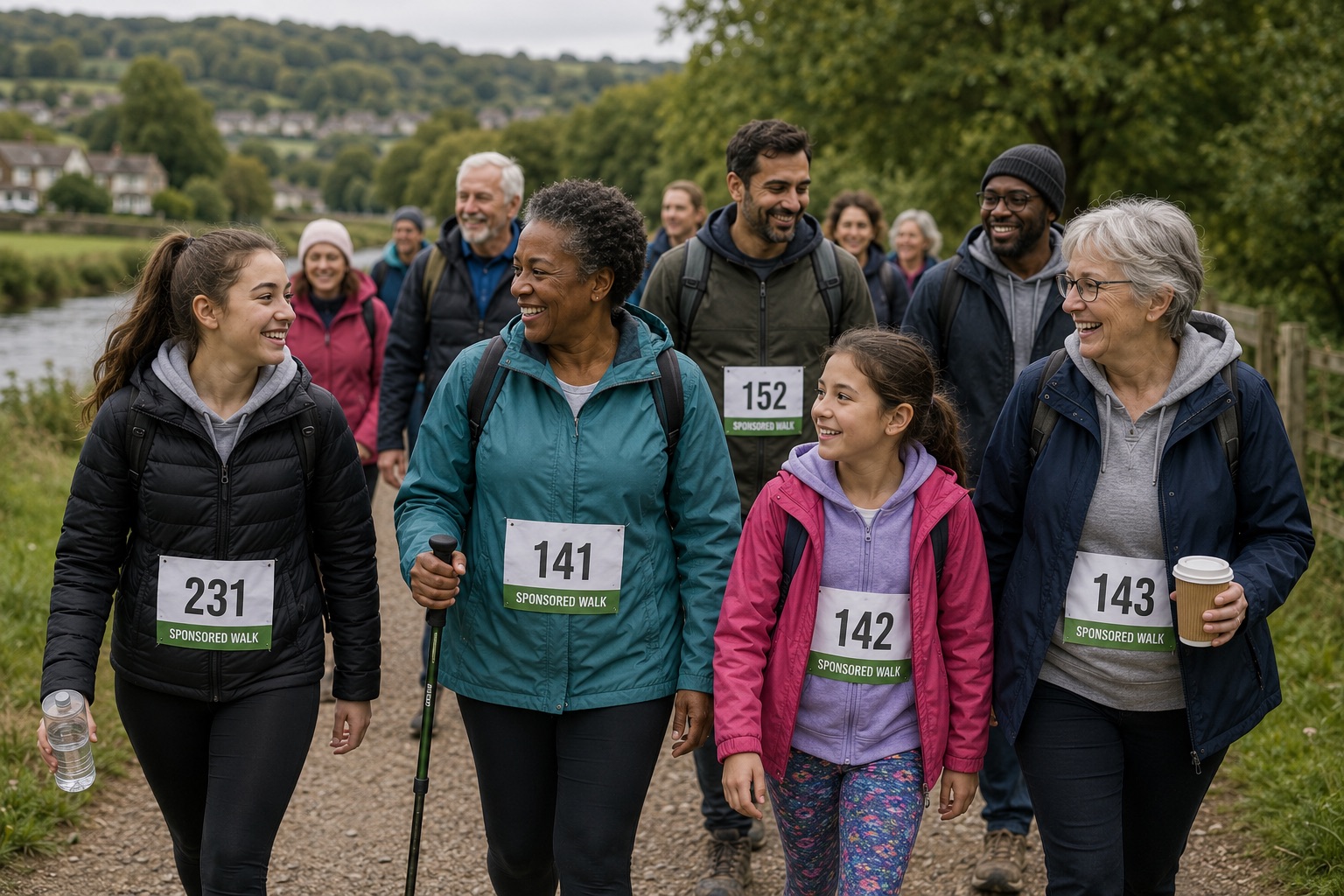
A sponsored walk is an event where participants walk an agreed route and raise money through sponsorship. Walkers gather at the start, follow the route together or at their own pace, and finish where the group decides. The route can be short (a mile around the village, a few laps of a field) or long (a 10km trail, a coastal hike, even a multi-day route). Whatever the distance, it is never a race. The point is taking part and raising money, not finishing first.
The defining quality is inclusivity. There's no fitness floor and no age limit. Toddlers in buggies, grandparents at walking pace, wheelchair users on a flat route, dog walkers, the keen hiker who'd rather stride out at the front. All in the same event, all welcome.
You'll also see the same idea called a charity walk, a walkathon, a sponsored hike, or a sponsored dog walk. They are the same event under different names. Pick whichever fits your group and your route.
The fundraising shape is the same as a fun run. The wider case for making a sponsored event the centrepiece of your group's fundraising year is covered in the fun run guide.
Pick a route, set a date, off you go.
The case
Five reasons.
The upgrade
Most groups still run the sponsored walk the way they always have. A paper sponsorship form handed out in advance, cash collected afterwards, a rough total announced at the next meeting. The walk itself is lovely. The admin is stuck in the past. Here is what changes.
Six upgrades.
The traditional walk raises money. The modern walk raises more, with less admin afterwards.
The distance
There's no fixed distance. The right length is whatever suits your group and the least able participant.
A few concrete reference points.
A point-to-point walk between two landmarks works well too. Two local churches, or two primary schools in the same trust walking towards each other for a joint event. It takes a little more planning for the start and finish, but a shared destination gives the walk a sense of occasion.
Whatever you pick, set the distance for the people taking part, not for the strongest walker. The whole appeal of the format is that everyone finishes together.
The numbers
A sponsored walk for a medium-sized group can raise between £2,000 and £3,500. The size of the group, the level of individual sponsorship, whether you charge an entry fee, and whether refreshments are part of the event all affect the total. Two things affect the total far more than anything else. How many people take part. And whether each one sets up an individual sponsorship page.
Take a scout group of 100 walkers, including children, leaders and parents, walking a 5km circular route through a country park as their summer fundraising event. Entry is £3 per walker, covering a route map and a fact-hunt sheet.
Entry fees: 100 × £3 = £300
Three-quarters set up an individual sponsorship page. The average page raises £25, in the middle of the realistic range for sponsored events.
Sponsorship: 75 × £25 = £1,875
Refreshments (tea, coffee, juice and cake) at the start and finish, roughly £250.
Total revenue: £2,425
Costs (covered in the next section), roughly £175.
Net to the group: around £2,250.
These are realistic mid-range figures. Two things move the total. The first is how many people take part, and a walk's broad all-ages appeal means almost anyone in your group can. The second is whether each walker has their own sponsorship page. Family and friends who can't be there in person can still give in seconds, the same as for any sponsored event.
The school version works the same way at larger scale. A 240-pupil primary school doing a walk around the village raises proportionally more, with more walkers translating to more individual pages and a bigger total.
Try the sponsored event calculator with your own numbers.
How the money adds up
Four sources, in order of contribution.
Entry fee. Often £2 to £5 per walker, sometimes including a route map and a fact-hunt sheet. Many groups waive it entirely and rely on sponsorship alone. The fee signals participation rather than charity, but it isn't where the money comes from.
Individual sponsorship. The biggest source. Each walker has their own online page with their name on it. Family and friends give in seconds, by card or phone, whether or not they can be there on the day. For why this matters, see the case for individual sponsorship pages.
Flat amount, not per mile. Flat-amount sponsorship is simpler and better for everyone. The supporter agrees a single amount and knows exactly what they're giving the moment they give it, with no surprise total arriving after the event and no being asked again once the miles are counted. The walker walks the route, with nothing riding on the distance. Both are done in seconds, and the money is in from the start rather than chased afterwards. Older sponsored walks sometimes used per-mile pledges settled in cash later. Flat-amount online sponsorship gives the same encouragement without the uncertainty for the sponsor or the collecting afterwards.
Refreshments. A well-staffed stall at a well-attended event earns £200 to £400. On a circular walk the stall sits at the start-and-finish point. On a point-to-point walk it sits at the destination. Either way, walkers arrive hungry and thirsty, and supporters who've come to meet them stay for a cup of tea.
The costs
A sponsored walk is the lowest-cost sponsored event you can organise. A route, a few marshals from your group's volunteers, some refreshments stock, and the group's existing first-aid arrangements cover the event.
Typical costs for a sponsored walk of 100 to 200 walkers, at 2026 prices. Suppliers vary.
| Item | Typical cost |
|---|---|
| Route signage and markers | £0 to £50 |
| Refreshments stock | £80 to £200 |
| Medals or certificates (optional) | £0 to £150 |
| Promotional materials | £0 (group's communications and messaging channels) |
| Typical total | £80 to £400 |
The timeline
Work backwards from the event date. A sponsored walk takes less time to organise than most sponsored events, but starting earlier than you think still pays off in calmer reminders and a better turnout.
The event
A sponsored walk has the lightest event-day footprint of any sponsored event format. A 100-walker event needs about eight volunteers. Setup is 30 to 45 minutes. The walk itself takes anywhere from 30 minutes (a primary school field lap) to a full day (a challenge trail). Cleanup is minimal.
Marshals along the route at junctions, crossings and any unclear turns. Sign-in and sign-out at the start. A designated first-aider. Two or three at the refreshments stall, more for a bigger event. One or two nominated photographers, agreed in advance. Follow your group's photography and sharing policy. Someone in overall charge with a copy of the plan and the marshal positions.
Sign every walker in at the start. Brief everyone on the route, the fact-hunt sheet if you're using one, and where the marshals are. Set off as one group, or in small clusters for a longer trail. The faster walkers will finish first. Slower walkers and anyone walking with younger children come in later, at their own pace. Sign every walker back in at the finish.
No timing, no waves, no laps to count. Walk, talk, look at the clues, finish when you finish.
A sheet of questions with answers along the route gives the walk texture and gives children a reason to look up. A wall plaque, a date on a stone, the colour of a particular door. Marshals can hint at where to look. Award the best score a prize at the finish, ideally a low-stakes prize that the youngest walker has a chance of winning.
On a circular walk the stall sits at the start-and-finish point and stays open from before the first walkers set off through to when the last finish. On a point-to-point walk the stall sits at the destination and opens before the first walkers arrive. Tea, coffee, juice and cake do well. Walkers arrive thirsty and hungry. Supporters who've come to meet them stay for a cup.
The pitfalls
Words you can use
Three templates you can adapt for your own event. Drop in your group's name, the date, and the cause.
Hello everyone,
On [date] we'll be holding our sponsored walk at [venue], starting at [time]. The route is [distance] and takes anyone at any pace. The money raised will pay for [cause].
Entry is £[3] per walker, which covers [a route map and a fact-hunt sheet]. We're asking each walker to set up a quick online sponsorship page that they can share with family and friends. Grandparents, godparents, friends and anyone who can't be there in person can sponsor in seconds. No paper form to lose, no cash to send in.
Wear comfortable clothes and shoes you can walk in. Bring water and something for the weather. We'll have [tea, coffee, juice and cake] at [the start and finish] for everyone afterwards.
You can sign up and set up your sponsorship page at [link].
Hi everyone, I'm taking part in [group's] sponsored walk on [date] to raise money for [cause]. I'll be walking [distance / the route]. Any sponsorship is hugely appreciated, however small. Thanks for backing me.
Thank you so much for sponsoring me in the sponsored walk. Between us we raised £[total]. [Add a personal sentence of detail. The sun came out for the first time in weeks, the whole group finished together, the youngest walker beat everyone on the fact hunt.] Thank you for being part of it.
FAQ
A sponsored walk is an event where people walk an agreed route to raise money. Family, friends and supporters pledge a flat amount in advance, the walker completes the route, and the money goes to the cause. It works best when each walker has their own online sponsorship page, so most pledges are made and paid online before the walk. The walker just shows up and walks.
There's no fixed distance. A primary school walk might be a mile or a few laps of the field. A community walk is often 3 to 5km. A challenge walk for keen walkers can run from 10km up to marathon distance. The principle is the same in all cases. Set the route for the least able participant, because the whole appeal of the format is that everyone finishes.
Online sponsorship works better for everyone. The supporter knows exactly what they're giving and pays in seconds by card or phone, with no chasing cash in the week after the walk. Family who live too far away to see a paper form can give from anywhere. And the treasurer isn't matching cash to names from a smudged sheet. Online pages also capture Gift Aid declarations as the supporter gives, so eligible donations are worth 25% more with no extra paperwork for the treasurer. Flat-amount online pages are simpler for everyone and reliably raise more.
It depends on the route and the size of the walk. A walk on private land your group already uses needs less than a walk on public roads or through a town centre. As a rule, check with the landowner of any private route, the local authority for any public route, and your group's own insurer for cover that fits the day. Your committee or governing body will know what's standard for your group. We can flag the questions to ask. The answers are theirs to give.
A walk in light rain is fine. Most walkers enjoy it more than they expect. Walk anyway, hand out hot drinks at the finish, and the photos will be the ones everyone remembers. Only thunder, lightning or sustained heavy rain calls for a contingency, and that contingency should be decided in advance.
Set up your sponsored walk page and give every walker their own sponsorship link. Family, friends and supporters give in seconds, wherever they are.
Free to set up. Small platform fee on entry fees.