The colour run guide
Colour run
A short, colourful run or walk that children love. With online sponsorship pages, it raises serious money.
The colour run guide
A short, colourful run or walk that children love. With online sponsorship pages, it raises serious money.
The format
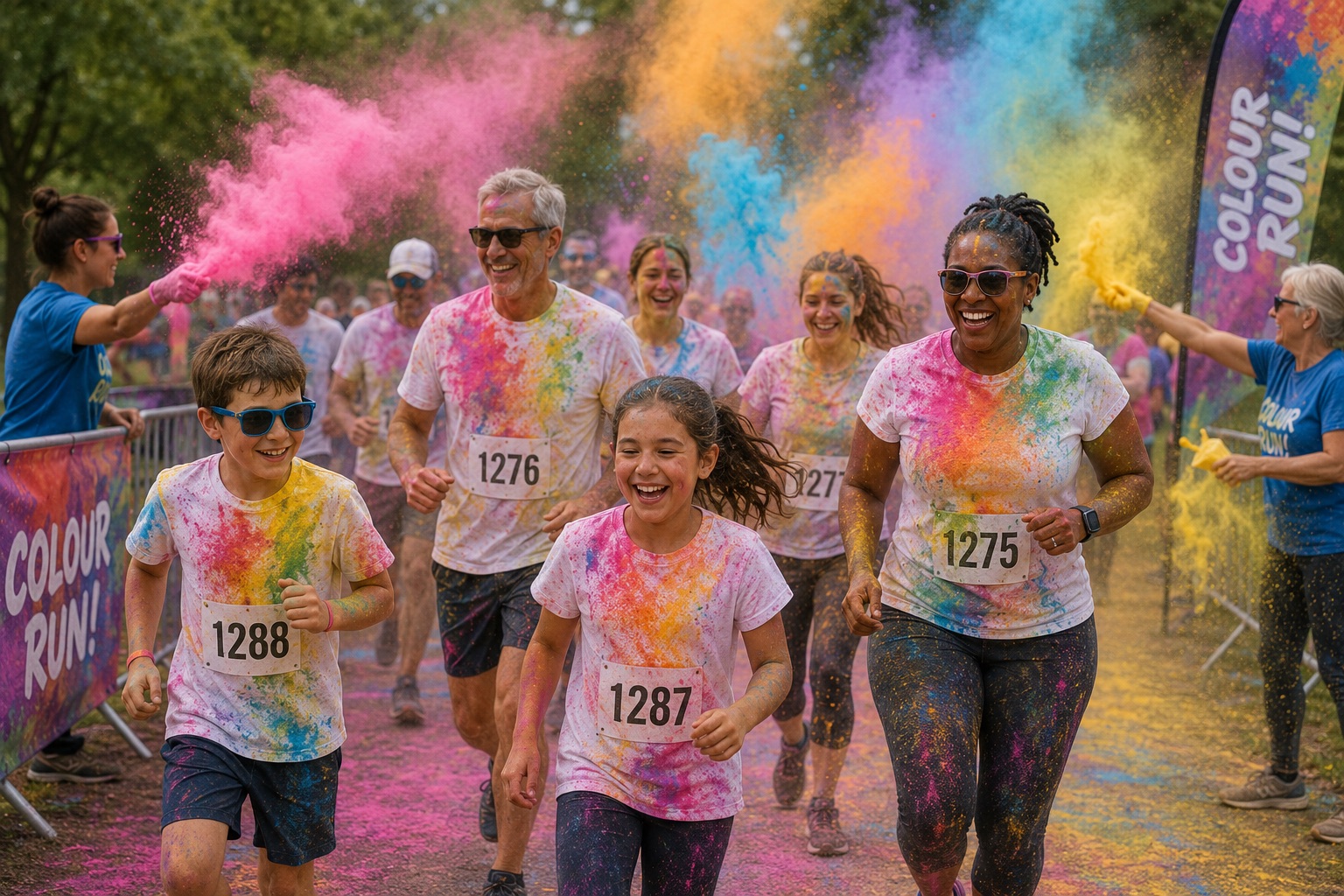
A colour run is a short course, usually on a field or in a local park, that participants run or walk in plain white t-shirts. Marshals stand at points along the route and throw small handfuls of brightly coloured powder as the children pass. By the finish line everyone is covered head to toe in colour, usually photographed, usually grinning. The whole thing is over in well under an hour.
The powder is cornflour-based with non-toxic food-grade dye. Reputable UK suppliers selling for use with children certify their powder to EN71, the European safety standard for products intended for use by children. It washes out of clothes and off the ground without staining. Buying safe, certified powder from a reputable UK supplier is the single most important decision in planning the event. Cheap unbranded powder online is not worth the risk.
The format draws on Holi, the Hindu festival of colours. Fundraising colour runs use similar safe powders to raise money, rather than as a religious observance.
The appeal is straightforward. The format works for children across nearly all ages. The spectacle produces strong photos for your group's newsletter and social channels. And it gives families an event that's genuinely different from the usual summer fête or Christmas fair. Children remember it for years.
Fit check
Five things to be honest about before committing.
If any of these don't work for you, consider a sponsored walk, a readathon, or a fun run without the colour element.
The numbers
A colour run with full group participation can raise between £4,000 and £12,000. The size of your group, the level of sponsorship engagement, and how the entry fee is structured all affect the total. Two things affect the total far more than anything else. How many children take part, and whether each child sets up an individual sponsorship page.
Take a group with 240 children. The organisers charge £5 entry, which includes a small bag of powder and a finisher's medal. 180 children sign up, a 75% take-up rate that's achievable with four to six weeks of promotion.
Entry fees: 180 × £5 = £900
Three-quarters of those children set up an individual sponsorship page. The average page raises £30, which sits in the middle of the realistic range. Half of pages raise less; a small number raise significantly more.
Sponsorship: 135 × £30 = £4,050
Additional revenue from selling extra colour-powder bags at the event and refreshments: roughly £400.
Total revenue: £5,350
Costs (covered in detail in the next section): roughly £900.
Net to the group: around £4,450.
These are realistic mid-range figures. With strong promotion and most children creating their own sponsorship pages with a personal note about why they're running, the total can roughly double. With weak promotion and a generic donation page, it can halve.
The worked example is illustrative. Your numbers will differ depending on the size of your group, your community, and how much promotion you have time for in the four weeks before the event.
Try the sponsored event calculator with your own numbers.
How the money adds up
A colour run makes money in four ways. Most of the money raised comes from individual sponsorship, but the entry fee carries the costs and the business sponsorship makes the upfront powder spend safe.
Entry fee. £5 per child is the typical figure. The fee covers the powder bag and a finisher's medal. That makes the event feel like a real participation experience, not a sponsorship form with extras. It also covers most of your fixed costs before any sponsorship comes in.
Individual sponsorship. The bigger lift comes from each child having their own online sponsorship page. Family, grandparents, the godparent who lives two counties away, work colleagues of parents. These are the supporters your in-person community doesn't reach through events alone. A child's individual page, with their name on it and a sentence about why they're running, raises substantially more than the same child handed a paper form.
For why this matters, see the case for individual sponsorship pages. The short version: a personal ask works in a way a generic one doesn't.
Business sponsorship. Approach two or three local businesses to sponsor a specific element of the event. The colour powder. The medals. The refreshments. Businesses are far more willing to back a defined item than to make a general donation. In exchange they get their name on the event banner, a thank-you in your group's newsletter, and credit on the sponsorship page. £150 to £300 to cover the powder is a typical ask. This is particularly valuable where parent sponsorship is going to be tight, since the business contribution covers the upfront cost.
Extras on the day. Selling extra bags of powder (parents and spectators love throwing them) and refreshments. Small amounts, but they add up over a couple of hundred children and they're almost pure margin.
The costs
Before any of the costs make sense, one safety note. Order powder from a UK supplier that certifies their product to EN71, the European safety standard for products intended for use by children. Confirm certification in writing before ordering. Your group's safeguarding lead and insurer have the final say on what's acceptable; treat this as the starting point.
Typical costs for a colour run for 200 children, at 2026 prices. Suppliers vary.
| Item | Typical cost |
|---|---|
| Coloured powder (EN71-certified, 200-participant pack including extra sale bags) | £400 to £600 |
| Finisher's medals (200) | £100 to £200 |
| Refreshments stock | £80 to £150 |
| Disposable gloves for marshals (one box) | £5 to £10 |
| Typical total | £585 to £960 |
Optional extras that some groups add. Printed posters and banners (£40 to £80), branded finish-line tape or arches (£50 to £150 to hire), professional photographer (£200 to £400). None of these are needed for a successful event; add them only if you have the budget and the time to organise them.
The powder is the dominant cost. Most suppliers offer participant packs sized to 100, 200, 300, or 500 children. A reputable supplier will send you the EN71 certification document on request and be open about their safety testing.
A cost-recovery move worth knowing about. Extra colour-powder bags sold on the day at £1 to £2 each typically generate £200 to £400 in additional revenue. Run a small fenced-off "free for all" area at the finish line where children, parents, and teachers throw their bought bags at each other. This is where the photography opportunity peaks, and it easily doubles powder-bag sales.
The timeline
A typical timeline runs from three months out to the day itself. Powder ordering is the longest lead time; everything else can move faster if needed.
The event
A colour run is more structured than a sponsored walk and less complex than a full sports day. A 200-child event needs roughly 15 volunteers. Setup takes 60 to 90 minutes, the event itself runs 60 to 90 minutes, and cleanup takes about an hour. The most stressful 20 minutes are the start; once the first wave is running, everything settles.
Marshals at powder stations, one per station and roughly one station per 25m of course. A registration check-in desk. A designated first-aider. Two or three at the refreshments stall. One or two nominated photographers, agreed in advance with the venue, taking the official photos that get shared afterwards. Follow your group's photography and sharing policy. Someone in overall charge with a copy of the plan, who volunteers can find if a question comes up.
Marshals wear disposable gloves when handling powder. The powder is safe to touch; the gloves are about keeping volunteer hands clean for the post-event packing-up, since pigment can temporarily stain skin.
Stage starts by age group. Youngest children first, smaller groups, slower pace. Older children later. Each child runs the course once. Marshals throw small handfuls of powder as the child passes. Never at the face. Music helps. A short warm-up at the start helps too, especially for the youngest, and gives latecomers a moment to register before the first wave goes off.
Throw less for the youngest children. A small pinch is plenty. Save the bigger handfuls for the older children, who'll be disappointed if there isn't much powder. Hold some powder back for the free-for-all at the end so the marshal stations don't run out before the last wave goes through.
After the timed runs, open a fenced-off area where anyone, including parents, teachers, group leaders, and the children themselves, can throw their bought bags. This is when the photo opportunity is at its peak, and it's where most of the extra powder-bag sales happen. Have an extra volunteer or two on the powder-bag stall during this stretch.
Powder sweeps off tarmac with a broom. On grass, rain takes care of it within 24 hours. The cleanup plan should be whatever was agreed with the venue at the planning stage. If anything is unclear on the day, talk to whoever's responsible before people leave.
The pitfalls
The mistakes most first-time organisers make.
Words you can use
Three templates you can adapt for your own event. Drop in your group's name, the date, and the cause.
Dear parents and carers,
On [date] we'll be holding a colour run at [venue]. Children will run a short course while volunteers throw clouds of brightly coloured powder. The powder is cornflour-based, certified safe for use with children, and washes out of clothes. The whole event is over in under two hours.
Entry is £5 per child, which covers a bag of powder for use on the day and a finisher's medal. We're also asking each child to set up a quick online sponsorship page that they can share with family and friends. The money raised goes to [cause].
Please send your child in old clothes they don't mind getting colourful. Tie long hair back. The powder brushes off with a good shake and washes out in a normal wash. We'll have water and refreshments available on the day.
Sign-up and sponsorship pages: [link]
Hi everyone, I'm running in [organisation] colour run on [date] to raise money for [cause]. I'm going to be covered head to toe in colour. Any sponsorship is hugely appreciated, however small. Thanks for backing me.
Thank you so much for sponsoring me in the colour run. Between us we raised £[total]. [Add a personal sentence of detail. For example, a sunny morning, a hundred children running, the venue a rainbow of powder.] Thank you for being part of it.
FAQ
Light rain is fine. The powder clumps slightly rather than dispersing in clouds, but it shows up more vividly on wet clothes and the photos are often better. Only cancel for thunder, lightning, or sustained heavy rain. Have a wet-weather plan ready in advance so the call on the day is quick.
Yes, if you buy correctly. Order from a UK supplier that certifies their product to EN71, the European safety standard for products intended for use by children. Confirm certification in writing before ordering. Avoid unbranded powder online, where you can't verify the safety. Sunglasses help, particularly for younger children. Your safeguarding lead and insurer have the final say on what's acceptable.
No. Certified colour-run powder washes out of cotton t-shirts and trainers in a normal wash. Brush off the loose powder before going indoors.
The powder brushes off easily with a good shake; most of the loose powder is gone within a minute. A short walk afterwards drops most of the rest. Clothes go in a normal wash, skin washes off in a bath or shower. Lay an old towel on the car seat for the journey home.
Holi is the Hindu festival of colours. Fundraising colour runs use similar safe powders to raise money, rather than as a religious observance.
Set up your colour run page and give every participant their own sponsorship link. Each child raises through their own network.
Free to set up. Small platform fee on entry fees.